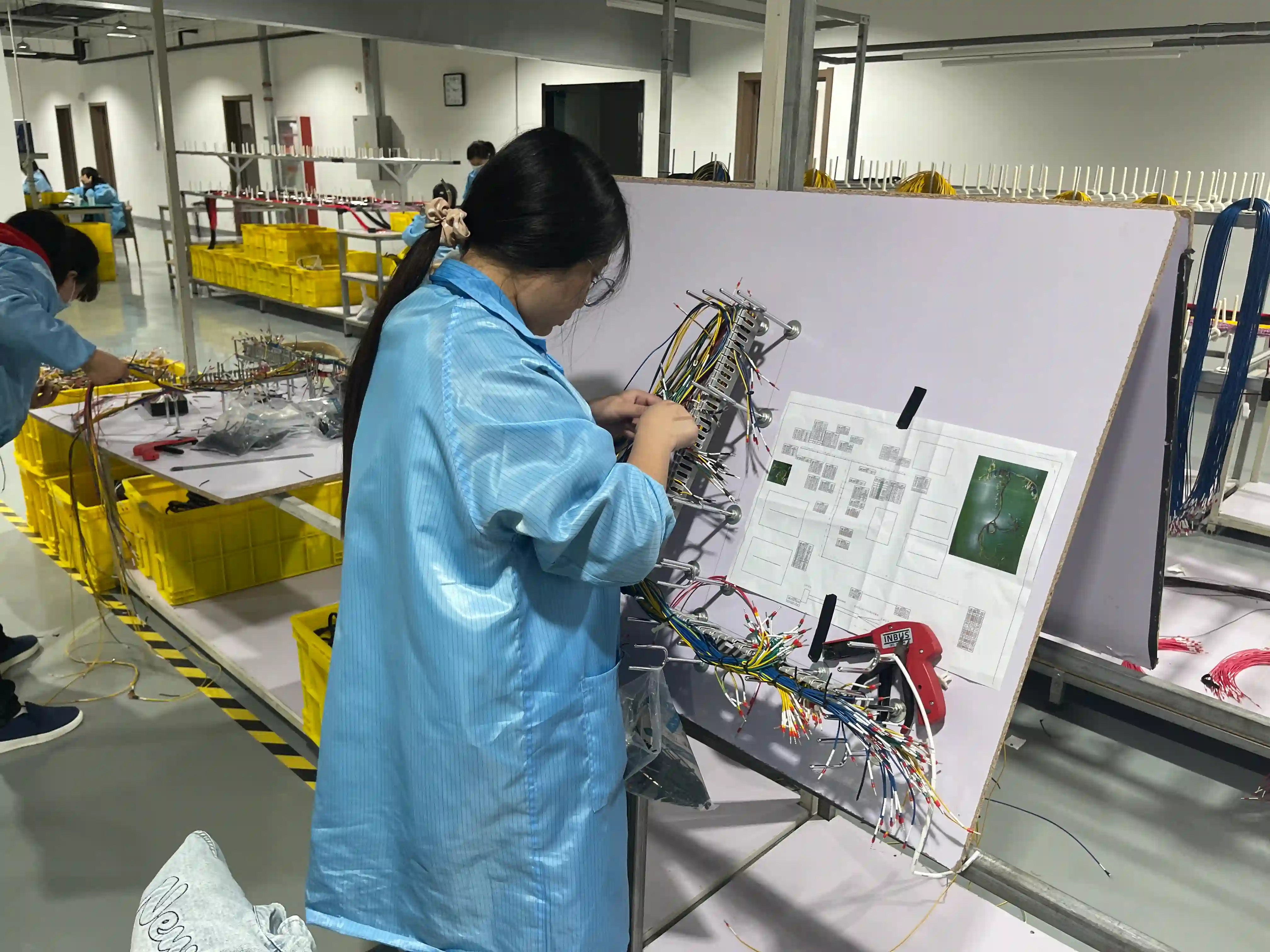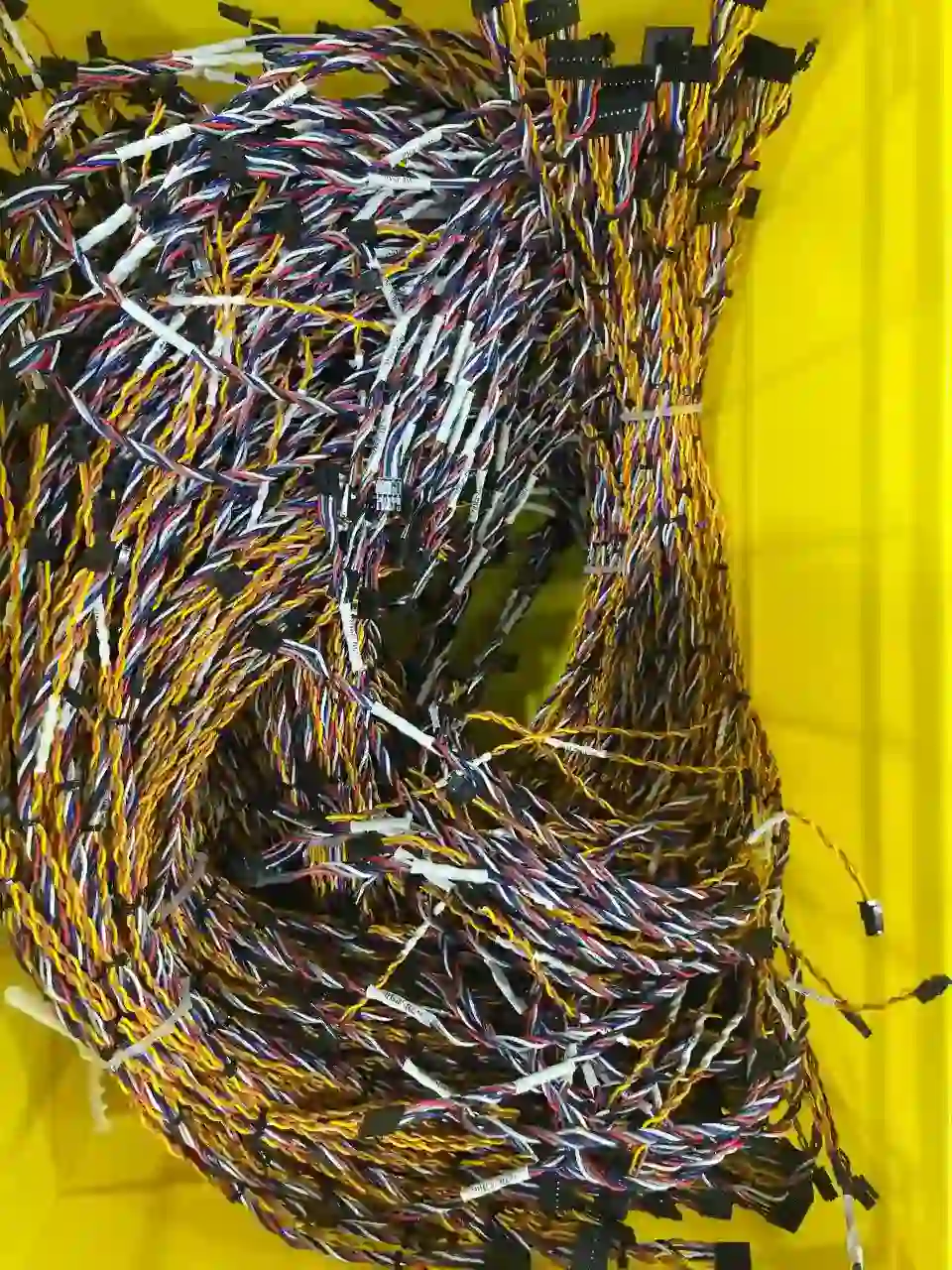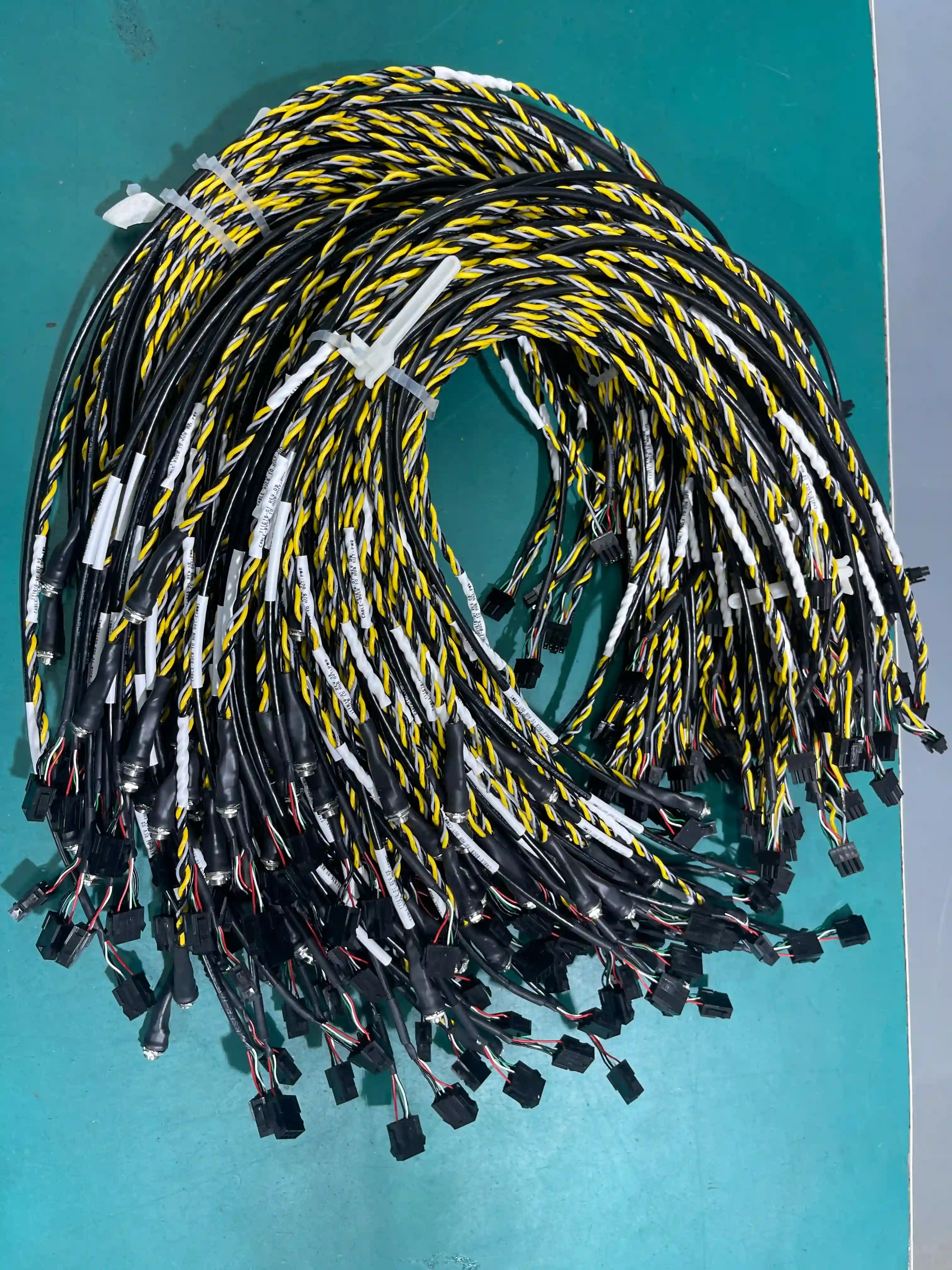
In a 2025-Q4 to 2026-Q1 Australian mining cable assembly project, the customer expanded a custom wiring harness inquiry into highly specialized braided cables with 3 Core (Yellow, Red, Blue), 18 AWG GXL, Black braid with 2 blue stripes, 50m or 100m rolls, laser-etched identification, and injection-molded connectors. The challenge was not only sourcing material; the factory had to prove that color coding, marking durability, connector molding, and production repeatability could stay controlled together.
TL;DR: custom braided mining cables need locked construction evidence
- Lock core colors, AWG, braid pattern, marking method, connector mold, and test plan before quoting production.
- Use IPC-A-620 workmanship language and UL-758 wire-style controls, but define mining loads on the drawing.
- Laser markings help traceability only when position, contrast, abrasion exposure, and roll length are specified.
- Injection-molded connectors protect terminations when tooling, bend exit, and pull-test criteria are approved together.
A custom braided cable assembly is a finished cable product that combines conductors, braid or sleeve, identification, connector termination, strain relief, and final electrical testing into one controlled assembly. 18 AWG GXL wire is an automotive-style cross-linked insulated wire size often selected when abrasion, temperature, and routing space matter. Laser-etched cable marking is a permanent identification method that marks the jacket, sleeve, tag, or molded surface without relying on loose labels.
This guide is written for mining equipment engineers, maintenance teams, and sourcing managers who already have a cable concept or worn field sample and are deciding whether a supplier can build it repeatably. The role behind the article is a senior factory engineer with more than 20 years in cable assembly, wire harness production, connector termination, molding, and supplier recovery. The objective is specific: turn a special braided cable request into a buildable RFQ with standards, concrete numbers, and inspection gates.
— Hommer Zhao, Grundlegger & CEO: When a customer specifies 3 Core (Yellow, Red, Blue), 18 AWG GXL, and Black braid with 2 blue stripes, I treat those details as product requirements, not styling preferences.
Why mining cable assemblies need tighter specification
Mining cable assemblies live in a rougher service environment than normal cabinet wiring. They may be dragged during maintenance, routed near vibration, exposed to dust, handled with gloves, washed down, or replaced far from the original factory. A cable that is electrically correct on a bench can still fail if the braid frays, the marking disappears, the molded connector cracks, or the wire colors no longer match the technician's field instructions.
The Australian case shows the buying-stage problem clearly. The customer did not ask for a generic multi-core cable. They asked whether the supplier could source and manufacture exact braided cable specifications, including core colors, AWG size, stripe pattern, laser-etched markings, and injection-molded connectors. That is a capability question, a material-sourcing question, and a process-control question at the same time.
The weak answer is "we can customize cable." The concrete substitution is: "we can build 3 Core (Yellow, Red, Blue), 18 AWG GXL cable with Black braid with 2 blue stripes, release 50m or 100m rolls, define laser marking location, mold the connector exit, and verify continuity, polarity, visual braid pattern, marking legibility, and strain relief before shipment." That sentence gives engineering and purchasing something they can inspect.
Case: braided mining cable scope expansion
During the project window from 2025-Q4 to 2026-Q1, the mining customer expanded the inquiry after seeing that the supplier could address more than one cable problem. The original wiring harness conversation grew into custom braided cable work with specific conductor colors, GXL wire, braid striping, identification, and molded connector requirements.
The factory response was to confirm the exact construction elements one by one. First came conductor definition: 3 Core (Yellow, Red, Blue) and 18 AWG GXL. Then came external identification: Black braid with 2 blue stripes. Then came production format: 50m or 100m rolls. The marking and connector plan followed, with laser-etched identification and injection-molded connector integration treated as release items rather than late decoration.
The result was increased trust from the customer and a broader inquiry scope. The practical lesson is that special mining cable work is won by proving the details. A supplier who can only quote wire gauge and connector type may miss the field problem. A supplier who can lock color, braid, marking, mold, length, test, and packaging gives the buyer a path from trial order to repeatable maintenance supply.
Standards and controls that belong in the RFQ
IPC-A-620 through IPC is useful because it gives shared workmanship language for cable and wire harness assemblies. For a braided mining cable, use it to frame acceptance of conductor preparation, termination workmanship, insulation condition, sleeve handling, and finished assembly inspection. IPC-A-620 does not decide your stripe pattern or roll length; those have to be written into the drawing or purchase specification.
UL-758 through UL matters when appliance wiring material style, insulation rating, temperature class, or traceability is part of the approved construction. If the RFQ says 18 AWG GXL, the supplier should not quietly replace it with a different insulation family because it is easier to source. For broader quality-system language, ISO 9001 supports document control, purchasing control, inspection records, and change approval.
Mining buyers should also define their own field-driven controls. State abrasion exposure, cleaning method, bend area, minimum marking height, connector pull target, polarity test, acceptable braid color tolerance, and packaging requirements. Standards help align language, but the actual service risk belongs in the application notes.
— Hommer Zhao, Grundlegger & CEO: IPC-A-620 can guide workmanship, but it will not tell my operator where the two blue braid stripes must sit. That detail has to live in the customer drawing or work instruction.
Comparison table: what to lock before release
| Requirement | Specify this detail | Factory control point | Risk if unclear | Release evidence |
|---|---|---|---|---|
| Core construction | 3 Core (Yellow, Red, Blue), 18 AWG GXL | Incoming wire check by color, gauge, insulation family, and lot | Wrong field wiring or unsupported insulation substitution | Material record, cut list, and first-article photos |
| Braid pattern | Black braid with 2 blue stripes | Braid source approval and visual orientation check | Maintenance team cannot identify the cable quickly | Approved sample photo and production inspection sheet |
| Roll format | 50m or 100m rolls | Measured length, roll ID, tie method, and carton protection | Installer receives short or damaged field stock | Length record and packing list by roll |
| Laser marking | Text, position, repeat interval, contrast, and abrasion exposure | Marking fixture, power setting, and legibility check | Traceability disappears after handling or cleaning | Mark sample, photo record, and inspection approval |
| Injection-molded connector | Connector family, mold material, cable exit angle, and strain relief length | Mold tool, adhesion, void check, and bend-exit review | Connector passes continuity but fails under pull or flex | FAI photos, pull test, and 100% continuity test |
| Electrical test | Continuity, shorts, polarity, and any insulation-resistance limit | Dedicated test fixture and operator record | Correct-looking cable ships with crossed cores | Serialized or lot-based test report |
The table prevents the RFQ from collapsing into a price-only exercise. In special cable work, the cheapest quote often hides open assumptions: the braid supplier is not fixed, marking is treated as optional, roll length is approximate, or the molded connector has no pull-test target. Those open assumptions turn into field issues after the first shipment.
Braid and marking decisions for field service
A braided outer layer can protect the cable, identify the cable, or do both. For mining equipment, visual identification matters because technicians may replace a cable under time pressure. If the cable uses a black braid with two blue stripes, the drawing should show stripe count, stripe color, stripe width tolerance if required, and whether stripe orientation matters at the connector end.
Laser-etched markings should be specified with the same discipline as a connector. Define the exact text, language, logo use if any, part number, revision, lot code, date code, roll number, repeat interval, and mark position. If the assembly ships as 50m or 100m rolls, identify whether every roll needs a start-end label, repeated jacket marks, or both.
For related production decisions, NorKab's wire harness traceability and labeling guide explains how labels, lots, and revision control prevent mixed shipments. If the cable also needs abrasion protection or sleeve selection, the nylon sleeve guide gives a practical comparison of sleeve fit, fraying, and heat treatment.
Injection-molded connectors and strain relief
An injection-molded connector is a connector termination protected by molded polymer around the cable exit, contacts, and strain-relief zone. The mold can improve sealing, handling strength, and repeatability, but only when the cable OD, jacket material, connector geometry, and mold compound are compatible. A hard mold over a flexible cable can create a stress riser if the exit geometry is too abrupt.
For mining cable assemblies, ask the supplier to define mold material, shore hardness if available, mold length, exit angle, color, logo or text, gate witness acceptance, flash acceptance, void inspection, and pull-test method. If the cable will bend repeatedly near the connector, combine the molded connector review with a bend-radius review rather than checking each feature in isolation.
NorKab's overmolding capability, cable testing capability, and mining equipment cable assembly service are the closest internal references for molded ends, production testing, and field-duty cable requirements. For connector exit design, the strain relief guide covers the trade-off between flexibility and termination protection.
— Hommer Zhao, Grundlegger & CEO: I do not approve a molded connector only from a clean photo. I want continuity, polarity, pull evidence, and a bend-exit check because mining service punishes weak transitions.
Supplier questions before you place the order
Start with sourcing proof. Ask whether the supplier can source 18 AWG GXL in the required core colors and whether they can hold the same insulation family during repeat orders. Ask whether the black braid with two blue stripes comes from an approved source, whether a color sample will be signed off, and how long the supplier needs to replenish material if roll demand increases.
Then review manufacturing proof. Ask for a first article with photos of core colors, braid pattern, laser marking, molded connector, cable exit, roll packaging, and test setup. A serious supplier should be able to explain which parameters are inspected 100%, which are sampled by lot, and which need customer approval before shipment.
For repeat mining programs, use a simple release path: prototype sample, first article approval, pilot roll, production lot, and revision-controlled reorder. That sequence keeps the buyer from approving a nice-looking sample while the factory still has open questions about material availability, marking contrast, mold tooling, or test-fixture coverage.
Evolve: replace vague durability wording with inspection language
The weakest section in many mining cable RFQs is the durability paragraph. A vague version says, "Cable must be durable and suitable for harsh mining use." That sentence is easy to quote and hard to inspect. A stronger version says, "Cable assembly shall use 3 Core (Yellow, Red, Blue), 18 AWG GXL conductors, Black braid with 2 blue stripes, laser-etched part and lot identification every agreed interval, injection-molded connector strain relief, 50m or 100m roll packaging, 100% continuity and polarity test, and customer-approved first article photos before production shipment."
That rewrite is longer, but it gives the supplier a real target. It tells purchasing what cannot be substituted, tells production what to build, tells inspection what to verify, and tells the maintenance team what they should receive in the field.
FAQ
Q: What should a custom braided mining cable RFQ include?
Include conductor count, exact colors, wire size, insulation family, braid color, stripe pattern, roll length, connector part number, molded strain relief, laser marking text, test requirements, and packaging. For the Australian case, the locked numbers were 3 Core (Yellow, Red, Blue), 18 AWG GXL, and 50m or 100m rolls.
Q: Is 18 AWG GXL enough information for production?
No. 18 AWG GXL defines an important wire size and insulation family, but production also needs core colors, cut length, strip length, connector termination, braid construction, marking method, roll format, and test criteria. Use UL-758 language for controlled wiring material when rating and traceability matter.
Q: How do laser-etched markings help mining cable maintenance?
Laser-etched markings can keep part number, lot, revision, or roll identity visible after handling. They work best when text height, contrast, repeat interval, and mark position are specified. On 50m or 100m rolls, repeated marks reduce the chance that a cut section loses its identity.
Q: When should the connector be injection molded instead of heat-shrink protected?
Use injection molding when the connector exit needs stronger strain relief, better sealing, cleaner handling, or repeatable shape. Heat shrink can protect lighter-duty transitions, but molded connectors are better when pull load, dust, cleaning, or repeated field handling is expected. Confirm pull-test and bend-exit criteria before approval.
Q: Which standards apply to custom braided cable assemblies?
Use IPC-A-620 for workmanship language, UL-758 for controlled wiring material references, and ISO 9001 for document control and supplier records. These standards support the release process, but customer drawings must still define braid pattern, markings, roll length, and connector molding details.
Q: What test evidence should ship with a mining cable assembly?
At minimum, request 100% continuity, shorts, and polarity test records, plus visual inspection for braid pattern, core colors, marking legibility, molded connector condition, and roll length. For higher-risk equipment, add pull-test evidence, insulation-resistance limits, and first-article photos tied to the approved revision.
Need a controlled custom braided cable build?
NorKab can review your conductor colors, AWG, braid pattern, marking method, molded connector, roll length, test fixture, and packaging plan before production. Contact NorKab with your cable drawing, field sample, target roll length, connector requirements, and mining environment notes so our team can map a buildable cable assembly plan.